
Table of Contents
ToggleFrance Geography, History, and Culture: A Complete Guide
Discovering France: A Journey Through Geography, History, and Culture
France, officially the French Republic, stands as one of Western Europe’s most influential nations. Renowned for its rich history, distinct regional landscapes, and enduring cultural impact, France has long served as a focal point for global art, philosophy, and political evolution.
Geography & Landscape
Often referred to as L’Hexagone (The Hexagon) due to its six-sided shape, France possesses a diverse geography that spans coastline, agricultural heartlands, and major mountain ranges.
- Borders & Oceans: France borders the Atlantic Ocean and the English Channel to the west and north, and the Mediterranean Sea to the south. Land borders connect it with Belgium, Luxembourg, Germany, Switzerland, Italy, Monaco, Spain, and Andorra.
- Topography: The nation’s terrain ranges from the coastal plains in the north and west to mountainous regions in the south and east. The Alps form a natural border with Italy and Switzerland, housing Europe’s highest peak outside the Caucasus, Mont Blanc (4,807 meters). The Pyrenees line the border with Spain, while the Massif Central occupies much of south-central France.
- Major Rivers: Four principal river systems drain the country: the Seine, flowing through Paris to the English Channel; the Loire, France’s longest river; the Rhône, flowing south toward the Mediterranean; and the Garonne, emptying into the Atlantic.
Historical Foundations
The history of France is characterized by dramatic shifts in governance, territorial expansion, and societal transformation.
- Ancient & Medieval Eras: Originally inhabited by Celtic tribes known as the Gauls, the region was conquered by Julius Caesar in the 1st century BCE, integrating it into the Roman Empire. Following the fall of Rome, Germanic tribes—most notably the Franks—established control. Under Charlemagne in the 8th and 9th centuries, the Frankish Empire expanded across Western Europe.
- Monarchy & Global Influence: By the late Middle Ages, the kingdom centralized under a monarchy. The 17th century marked the peak of absolute monarchy under King Louis XIV (the “Sun King”), who transformed France into Europe’s dominant cultural and military power.
- Revolution & Modern Era: The French Revolution of 1789 dismantled the monarchy, introducing principles of liberté, égalité, fraternité (liberty, equality, fraternity). The subsequent rise of Napoleon Bonaparte brought sweeping legal reforms via the Napoleonic Code. Across the 19th and 20th centuries, France transitioned through empires and republics, playing central roles in both World Wars before becoming a founding member of the European Union and a permanent member of the UN Security Council.
Culture, Economy, and Global Role
Modern France combines a strong industrial economy with worldwide leadership in luxury, fashion, gastronomy, and tourism. As one of the founding members of the European Union and the United Nations Security Council, France exercises substantial diplomatic, economic, and soft-power influence globally.
- Capital & Urban Hubs: Paris serves as the political, economic, and cultural center, attracting millions of international visitors and global enterprises every year. Beyond the capital, other major cities drive regional innovation and industry: Marseille operates as a vital Mediterranean maritime trade and logistics port; Lyon acts as the traditional culinary capital and a bio-tech engine; Toulouse dominates as Europe’s premier aerospace hub hosting Airbus; and Nice remains the glamourous heart of the French Riviera.
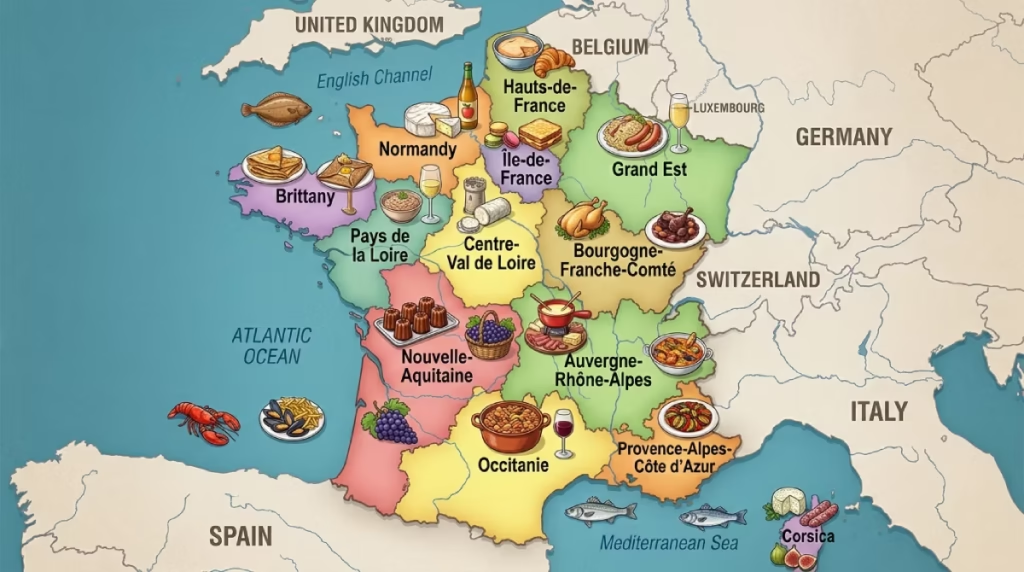
- Gastronomy & Wine: French cuisine is recognized globally for its emphasis on regional ingredients, technique, and heritage. Recognized by UNESCO as an Intangible Cultural Heritage, its culinary footprint spans from the historic vineyards of Bordeaux, Burgundy, and Champagne to regional specialties like artisanal cheeses, fresh baguettes, and intricate pastries. Wine production remains both an economic pillar and a core cultural identity marker.
- Economic Power & Industry: France boasts one of the world’s largest economies, driven by high-tech manufacturing, energy production, financial services, and agricultural exports. The nation is home to global conglomerates across diverse sectors, including automotive engineering, high-speed rail transportation (TGV), pharmaceutical research, and renewable energy. France is also the world’s top recipient of nuclear energy technology, ensuring a low-carbon domestic power grid.
- Luxury, Fashion & Tourism: As the most visited country in the world, tourism generates significant revenue across both urban landmarks and rural landscapes. Paris is celebrated as the global fashion capital, anchoring multi-billion-dollar luxury empires like LVMH, Kering, and Chanel that define worldwide consumer trends and artistic direction.
- Global Diplomacy & Cultural Reach: Through the Francophonie—an international community of over 300 million French speakers—France maintains deep diplomatic, linguistic, and educational ties across Africa, the Americas, and Asia-Pacific. Its global strategy balances strong European integration with an independent foreign policy, maintaining a formidable nuclear deterrent and military presence worldwide.